While FR4 is the undisputed workhorse of the PCB industry due to its low cost and excellent mechanical properties, it is not always suitable for high-speed or high-frequency applications. The primary reasons for its unsuitability lie in its electrical characteristics, specifically a relatively high and unstable Dielectric Constant (Dk) and a high Dissipation Factor (Df), or loss tangent. As signal frequencies increase into the gigahertz range, these properties lead to significant signal integrity issues, including unacceptable insertion loss, signal distortion, and impedance inconsistencies, ultimately compromising the performance and reliability of the final product.
Table of Contents
- What Defines a “High-Speed” PCB Application?
- The Core Electrical Limitations of FR4 for High-Speed Designs
- How Do These Limitations Impact Signal Integrity?
- When Should You Move Beyond FR4? A Practical Guide
- Exploring High-Speed PCB Material Alternatives
- Can You Still Use FR4 for High-Speed Designs? Mitigation Techniques
- Conclusion: Choosing Your Material is a Critical Design Decision
What Defines a “High-Speed” PCB Application?
Before diving into the limitations of FR4, it’s crucial to understand what “high-speed” truly means in the context of PCB design. The term is not just about a component’s clock frequency. A design is considered high-speed when the integrity of the signals on the board is affected by the physical characteristics of the PCB itself, such as its layout, layer stackup, interconnections, and—most importantly—the substrate material. This typically occurs when the signal’s rise time is very short, leading to high-frequency harmonics that extend well into the GHz range. As a general rule of thumb, many engineers consider designs operating above 1 GHz or with data rates exceeding 2.5 Gbps to be in the high-speed category where FR4’s limitations become a primary concern.
The Core Electrical Limitations of FR4 for High-Speed Designs
FR4’s popularity stems from its manufacturability and low cost, not its electrical performance at high frequencies. When signals travel through a PCB, the substrate material acts as a dielectric. Its properties are paramount to maintaining signal integrity. Here are the specific areas where standard FR4 falls short.
The Problem with Dielectric Constant (Dk) Inconsistency
The Dielectric Constant (Dk), also known as relative permittivity (εr), determines the speed at which a signal propagates through the material and is a key factor in calculating characteristic impedance. For FR4, there are two major issues with Dk:
- Frequency Dependence: Standard FR4 does not have a flat Dk response across frequencies. Its Dk value, typically around 4.5 at 1 MHz, can drop significantly as the frequency climbs into the GHz range. This variance means that different frequency components of a digital signal (e.g., the fundamental frequency vs. its harmonics) travel at different speeds, a phenomenon known as dispersion, which distorts the signal waveform.
- Material Inconsistency: FR4 is a composite material made of woven glass fabric and an epoxy resin binder. This composition is anisotropic, meaning its electrical properties are not uniform in all directions. The Dk can vary depending on the location on the board and the ratio of glass to resin in that specific area. This lack of uniformity makes precise impedance control, which is critical for high-speed signals, extremely difficult to achieve and maintain across the board.
The Signal Killer: Dissipation Factor (Df) and Insertion Loss
The Dissipation Factor (Df), or loss tangent (tanδ), is arguably the most critical parameter for high-speed design. It quantifies how much of the signal’s electromagnetic energy is absorbed and converted into heat by the dielectric material. A higher Df means more signal energy is lost as it travels down a trace. Standard FR4 has a relatively high Df, often in the range of 0.015 to 0.025. While this is negligible at low frequencies, loss is directly proportional to frequency and trace length. At multi-gigahertz frequencies, a high Df causes severe signal attenuation, a problem known as insertion loss. This can weaken a signal to the point where the receiver cannot correctly interpret its logic state, leading to high bit error rates (BER).
Moisture Absorption: The Hidden Variable Affecting Performance
FR4’s epoxy resin is hygroscopic, meaning it absorbs moisture from the environment. Water has a very high Dk (around 70-80), so even a small amount of moisture absorbed into the PCB substrate can significantly alter the material’s overall Dk and Df. This change can shift the impedance of traces and increase signal loss. For products deployed in environments with fluctuating humidity, this can lead to unpredictable performance and field failures, a risk that is often unacceptable in high-reliability applications like telecommunications or automotive systems.
Thermal Management and CTE Mismatch Challenges
High-speed devices often dissipate a significant amount of heat. The material’s ability to withstand high temperatures (Tg – Glass Transition Temperature) and its Coefficient of Thermal Expansion (CTE) are critical. While higher-grade FR4 offers decent Tg values, its CTE can be problematic. A large mismatch between the CTE of the copper trace and the FR4 substrate can cause immense stress on solder joints and plated through-holes (vias) during thermal cycling. This is especially true for large BGA packages with high pin counts, where CTE mismatch can lead to premature solder joint fatigue and failure.
How Do These Limitations Impact Signal Integrity?
The theoretical material deficiencies of FR4 translate directly into tangible, performance-degrading signal integrity (SI) phenomena. An engineer will observe these issues during simulation and lab validation.
Insertion Loss: The Fading Signal
As mentioned, the high Df of FR4 is the primary driver of insertion loss. Imagine shouting in a room with thick, soft curtains on the walls—your voice gets muffled and doesn’t travel far. Similarly, FR4 “muffles” high-frequency signals. For a long trace carrying a 10 Gbps signal, the insertion loss on an FR4 board can be so severe that the signal arriving at the receiver is too weak to be detected, whereas on a low-loss material like Rogers, the signal would remain robust and clear.
Dispersion and Signal Distortion
Because FR4’s Dk changes with frequency, the various sine waves that constitute a square-wave digital signal travel at different speeds. The higher-frequency harmonics, which are essential for creating sharp signal edges, are slowed down differently than the fundamental frequency. This causes the signal to “smear out” over time, turning a clean, crisp square wave into a rounded, distorted waveform. This distortion can cause the receiver to sample the signal at the wrong time, leading to errors.
Impedance Control Challenges
Controlled impedance is vital for preventing signal reflections that corrupt data. Impedance depends on the trace geometry and the Dk of the material beneath it. Since FR4’s Dk is inconsistent across the board and varies with frequency, achieving a precise 50-ohm (or 90-ohm differential) impedance becomes a significant challenge. These minor variations in impedance create reflections that add to the overall noise on the signal line, further degrading the signal quality.
The Result: Jitter, Noise, and Closed Eye Diagrams
The cumulative effect of insertion loss, dispersion, and impedance mismatches is a “closed” eye diagram. An eye diagram is an oscilloscope measurement that superimposes all bits of a digital signal on top of each other. A wide-open “eye” indicates a clean, high-quality signal with plenty of margin for the receiver to sample correctly. On an FR4 board used at high speeds, the eye will appear closed or collapsed due to excessive jitter (timing variations) and noise, indicating a high probability of bit errors and system failure.
When Should You Move Beyond FR4? A Practical Guide
Deciding to move away from FR4 is a balance of performance requirements and budget. It’s an engineering trade-off that requires careful consideration.
Frequency and Data Rate Thresholds
A widely accepted, though informal, threshold is around 3 GHz. For signals with significant harmonic content below this frequency, standard FR4 may be manageable. However, for applications involving PCIe 3.0 (8 Gbps), USB 3.1 (10 Gbps), 10G Ethernet, or RF signals above 3-5 GHz (e.g., 5G, Wi-Fi 6E, radar), a high-performance laminate is almost always necessary to meet performance specifications.
Trace Length Considerations
Losses are cumulative. For very short trace lengths (e.g., a few inches), FR4 might be perfectly acceptable even at higher data rates because the signal doesn’t spend enough “time” in the lossy material for significant degradation to occur. However, for backplanes, large motherboards, or long interconnects where traces can be 10 inches or more, the total insertion loss on FR4 will become prohibitive, forcing the use of a low-loss material.
Cost vs. Performance Analysis
High-speed laminates can cost 3 to 10 times more than standard FR4. The decision often comes down to this: Is the cost of a board re-spin or field failure greater than the upfront cost of using a better material? For consumer electronics with short product cycles, a designer might try to push the limits of FR4. For enterprise, medical, or aerospace equipment where reliability is non-negotiable, the higher material cost is an easily justified insurance policy against failure.
Exploring High-Speed PCB Material Alternatives
When FR4 is no longer viable, a new world of advanced laminates becomes available. These materials are specifically engineered for superior high-frequency performance.
Comparison Table: FR4 vs. High-Speed Laminates
This table provides a quick overview of the key differences between standard FR4 and a typical high-performance material.
| Parameter | Standard FR4 | High-Speed Laminate (e.g., Rogers RO4350B) | Impact on High-Speed Design |
|---|---|---|---|
| Dielectric Constant (Dk) | ~4.5 (Varies with frequency) | ~3.5 (Stable across frequency) | Stable Dk allows predictable impedance and prevents dispersion. |
| Dissipation Factor (Df) | ~0.020 | ~0.0037 | Low Df drastically reduces insertion loss, preserving signal strength. |
| Moisture Absorption | ~0.15% | ~0.06% | Lower absorption ensures stable performance in varying environments. |
| Cost | Low | High (3x-10x) | The primary trade-off when selecting a material. |
Popular Choices: Rogers, Isola, and Megtron
Several manufacturers specialize in high-performance PCB laminates. The most commonly cited names in the industry include:
- Rogers Corporation: Their RO4000® series (like RO4350B and RO4003C) are industry standards, offering excellent performance and the benefit of being processable with standard FR4 fabrication techniques. Their RO3000® series offers even lower loss for demanding RF and microwave applications.
- Isola Group: Materials like I-Speed®, I-Tera® MT40, and FR408HR offer a spectrum of performance levels, providing a good middle ground between standard FR4 and ultra-premium RF materials.
- Panasonic: Their Megtron® family, particularly Megtron 6 and the newer Megtron 7, are renowned for extremely low Dk and Df values, making them a top choice for the most demanding high-speed systems like data center servers and networking equipment.
The Hybrid Approach: The Best of Both Worlds?
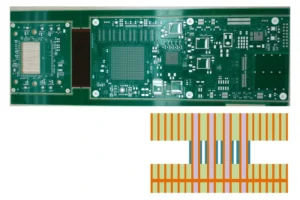
To manage costs, designers often employ a hybrid stackup. In this design, only the critical layers carrying high-speed signals are made from a low-loss laminate like Rogers. The other layers, typically used for power and ground planes or low-speed signals, are made from standard FR4. This approach provides the necessary performance for the critical nets while keeping the overall board cost lower than a pure high-speed material build. This requires close collaboration with the PCB fabricator to ensure compatibility and reliability during the lamination process.
Can You Still Use FR4 for High-Speed Designs? Mitigation Techniques
If budget constraints demand the use of FR4, all is not lost. Talented design engineers can use several techniques to push its limits, though these often add complexity to the design and validation process:
- Shorter Trace Lengths: Keeping high-speed traces as short and direct as possible is the most effective strategy.
- Wider Traces: Wider traces exhibit lower skin-effect loss, slightly mitigating insertion loss.
- Pre-emphasis and Equalization: Modern high-speed transceivers (SerDes) often include built-in circuits that can compensate for losses. Pre-emphasis boosts the high-frequency components of the signal at the transmitter, while equalization at the receiver can amplify the weakened frequencies, effectively “re-opening” the eye diagram.
- Use of Higher-Grade FR4: Not all FR4 is created equal. There are “high-performance” FR4 materials with lower Df values (e.g., around 0.009-0.012) that offer a middle ground between standard FR4 and materials like Rogers.
Conclusion: Choosing Your Material is a Critical Design Decision
In conclusion, while FR4 remains an excellent choice for a vast range of mainstream electronics, its inherent electrical limitations make it a risky and often unsuitable choice for high-speed, high-frequency PCB design. The unstable dielectric constant and high dissipation factor lead directly to severe signal integrity problems like insertion loss and dispersion, which can cripple system performance. As data rates and operating frequencies continue to climb, understanding the boundary where FR4 is no longer “good enough” is essential. The decision to invest in advanced low-loss laminates is not merely an expense; it is a critical engineering decision that ensures signal integrity, product reliability, and market success.
FR4 high-speed PCB, high-frequency PCB materials, signal integrity, FR4 limitations, dielectric constant, dissipation factor, insertion loss, Rogers vs FR4, when to use high-speed laminates, PCB material selection, high-speed design challenges, what is fr4 not suitable for