When selecting a ceramic substrate for power electronics, the decision often comes down to AlN vs alumina PCB materials.
The main difference is thermal performance. Aluminum nitride, or AlN, offers much higher thermal conductivity than alumina, also known as Al2O3. However, alumina is generally more economical, mechanically robust, widely available, and sufficient for many electronic assemblies.
For applications where heat removal is the primary design limitation, an AlN ceramic PCB is usually the stronger candidate. When thermal demand is moderate and cost efficiency matters more, alumina is often the more practical choice.
The correct material therefore cannot be selected from thermal conductivity alone. Electrical insulation, coefficient of thermal expansion, mechanical requirements, copper layout, operating temperature, processing complexity and total system cost should all be considered.
This guide compares the two substrates from an engineering and procurement perspective and explains when the additional cost of aluminum nitride is technically justified.
AlN and Alumina Are Both Ceramic PCB Substrates—But They Solve Different Problems
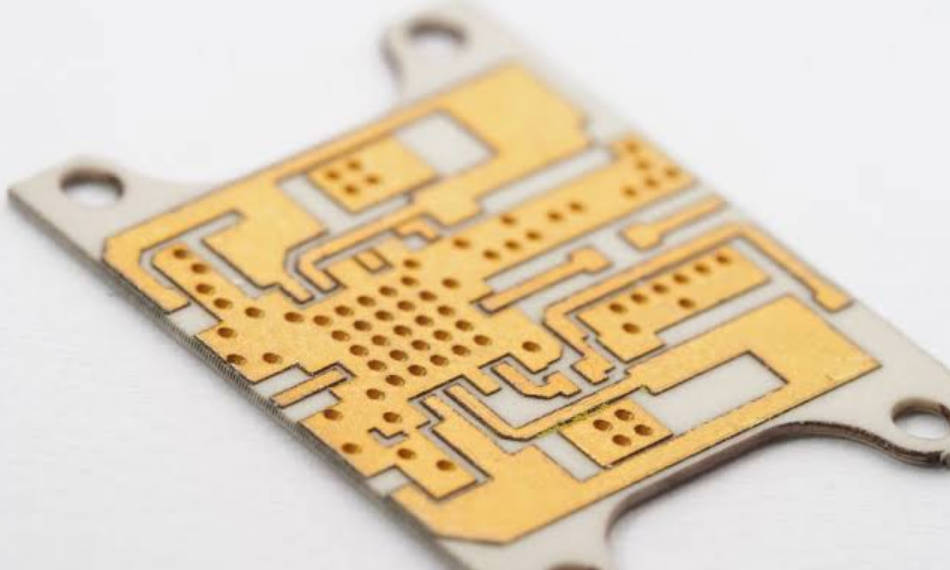
A ceramic PCB uses an electrically insulating ceramic layer rather than the conventional organic dielectric materials found in standard PCB constructions.
Two commonly considered ceramic materials are:
- Aluminum nitride — AlN
- Aluminum oxide / alumina — Al2O3
Both materials provide electrical insulation, heat resistance and dimensional stability. The difference lies in the balance of these properties.
Alumina is widely used because it offers a practical combination of electrical insulation, mechanical strength, manufacturability and cost.
AlN is selected primarily when the PCB must transfer substantially more heat away from semiconductor devices.
This difference sounds simple, but in a real PCB design it affects much more than substrate temperature.
A hotter substrate can influence:
- Semiconductor junction temperature
- Component lifetime
- Power density
- Thermal interface requirements
- Heat sink size
- Maximum operating current
- System reliability
- Overall enclosure design
For this reason, ceramic substrate selection should be made at the system level rather than by comparing material specifications in isolation.
The Most Important Difference: Thermal Conductivity
Thermal conductivity is the property that creates the largest performance gap between AlN and alumina.
Typical material values vary with purity, grade, manufacturing process and supplier, but common engineering ranges are approximately:
| Property | AlN Ceramic | Alumina Ceramic |
| Thermal conductivity | Commonly around 140–180+ W/m·K | Commonly around 20–30 W/m·K for widely used grades |
| Electrical insulation | Excellent | Excellent |
| Relative material cost | Higher | Lower |
| CTE compatibility with semiconductor materials | Very good | Good |
| Mechanical robustness | Good | Very good in many conventional applications |
| Typical use | High heat-flux electronics | Cost-sensitive general ceramic electronics |
The difference is significant.
AlN can provide several times the thermal conductivity of commonly used alumina substrates, allowing heat to move from a semiconductor through the PCB substrate much more efficiently.
That does not automatically mean an AlN PCB will make the entire electronic system several times cooler.
Actual thermal performance also depends on:
- Ceramic thickness
- Copper thickness
- Copper coverage
- Circuit geometry
- Die attach material
- Solder layer
- Thermal interface materials
- Heat sink design
- Airflow or liquid cooling
- Contact thermal resistance
This distinction matters when comparing quotations.
Selecting an expensive high-conductivity substrate will not compensate for a poorly designed thermal path elsewhere in the assembly.
Think in Terms of Heat Flux, Not Just Power Rating
A common mistake is to select PCB material based only on total device power.
For example, two systems might each dissipate 100 W, but their substrate requirements could be completely different.
A 100 W heat source distributed across a relatively large area may be manageable with alumina.
The same amount of heat concentrated underneath several small power semiconductor dies creates much higher local heat flux and can require AlN.
The engineering question therefore becomes:
How much heat must pass through how much area, and what maximum temperature rise can the system tolerate?
This is particularly important for:
- High-power LEDs
- Laser diodes
- Power MOSFETs
- IGBT modules
- Power conversion modules
- Automotive power electronics
- High-current switching devices
AlN becomes especially valuable when high heat flux and limited cooling area make substrate thermal resistance a meaningful part of the total junction-to-ambient thermal path.
AlN vs Alumina PCB: Engineering Comparison
Material selection becomes clearer when the substrates are compared according to the actual design constraints.
| Selection Factor | AlN PCB | Alumina PCB |
| Thermal conductivity | Excellent | Moderate |
| Electrical insulation | Excellent | Excellent |
| Heat spreading | Strong | Suitable for moderate loads |
| High power density | Highly suitable | Application dependent |
| CTE matching with silicon | Favorable | Less closely matched than AlN |
| Mechanical strength | Good | Often very strong |
| Processing difficulty | Higher | More mature and economical |
| Raw substrate cost | Higher | Lower |
| Availability | More specialized | Broad |
| Cost-sensitive volume production | Less attractive unless thermally required | Strong candidate |
| High-performance power modules | Strong candidate | Depends on thermal load |
| General electronic insulation substrate | Often unnecessary | Strong candidate |
No single row should determine the final choice.
The engineering objective is to identify which limitation is controlling the design.
Where AlN Ceramic PCB Has the Advantage
1. High Thermal Conductivity
This is the primary reason to specify an aluminum nitride PCB.
In high-power designs, heat generated at the component must travel vertically through the circuit structure toward a heat sink, housing or cooling plate.
Reducing thermal resistance across the ceramic layer can lower the temperature difference between the heat source and cooling structure.
That can help designers:
- Operate at higher power density
- Reduce thermal hotspots
- Improve thermal uniformity
- Protect temperature-sensitive components
- Increase design margin
Applications involving concentrated semiconductor heat loads are therefore more likely to justify AlN.
2. Better Thermal Expansion Compatibility in Certain Power Electronics
Ceramics and semiconductors expand at different rates as temperature changes.
Repeated thermal cycling creates mechanical stress at:
- Solder joints
- Bonding interfaces
- Metallization layers
- Semiconductor attachment points
AlN has a coefficient of thermal expansion that is relatively close to silicon compared with many conventional PCB materials.
This property can be valuable in assemblies experiencing repeated temperature cycling.
The advantage is particularly relevant when:
- Large semiconductor dies are mounted directly onto the ceramic circuit
- Operating temperature changes rapidly
- Power cycling is frequent
- Long-term thermal reliability is important
3. High Power Density in Limited Space
Sometimes improving airflow or increasing heat sink size is not practical.
Examples include:
- Automotive electronics
- Compact converters
- LED modules
- Industrial motor drives
- High-density power supplies
An AlN substrate can help reduce thermal resistance without increasing the PCB footprint.
This makes the material attractive where performance must be increased within a fixed mechanical envelope.
Where Alumina Ceramic PCB Makes More Sense
High thermal conductivity sounds attractive, but it should not be purchased unless the application benefits from it.
Alumina remains widely used because many circuits simply do not generate enough heat to justify AlN.
Cost Efficiency
Alumina raw material and manufacturing infrastructure are generally more economical.
For high-volume assemblies, the difference can significantly affect PCB cost.
If thermal simulation or prototype testing shows that alumina keeps the device safely within its temperature requirements, changing to AlN may provide little practical benefit.
The most cost-effective ceramic PCB is not the substrate with the highest thermal conductivity; it is the lowest-cost substrate that still satisfies the electrical, thermal and reliability requirements of the design.
Mature Processing
Alumina has been extensively used for electronic substrates.
Its broad industrial adoption contributes to:
- Mature material supply
- Established processing methods
- Flexible substrate options
- Predictable manufacturing
- Competitive pricing
This can make procurement easier for products where extreme thermal performance is unnecessary.
Strong Electrical Insulation
Ceramic PCBs are frequently selected because engineers need both heat resistance and electrical isolation.
Alumina offers excellent dielectric properties and can provide reliable electrical separation between conductive circuitry and the underlying mechanical or thermal structure.
Applications that require electrical insulation but only moderate thermal transfer may therefore gain little from upgrading to AlN.
Does AlN Always Provide Better Electrical Performance?
Not necessarily.
Thermal conductivity and dielectric performance should be treated as separate material characteristics.
Both alumina and AlN are electrically insulating ceramics and can be suitable for high-voltage electronic designs.
PCB-level electrical performance depends on more than the ceramic material itself, including:
- Ceramic thickness
- Material purity
- Surface condition
- Metallization geometry
- Conductor spacing
- Edge distance
- Operating environment
- Contamination
- Manufacturing quality
For high-voltage applications, engineers should therefore specify the required working voltage and insulation requirements instead of assuming that one ceramic automatically provides superior PCB-level isolation.
Mechanical Performance Can Change the Decision
Thermal requirements often dominate the comparison, but mechanical behavior should not be ignored.
Ceramics are hard and dimensionally stable but are fundamentally brittle materials.
PCB manufacturers must control:
- Substrate handling
- Cutting
- Drilling or laser processing
- Edge quality
- Metallization
- Warpage
- Assembly stress
Alumina is well established in applications requiring mechanically stable ceramic substrates.
AlN also provides useful mechanical properties, but its greater material cost means manufacturing yield and processing complexity become more economically important.
This becomes relevant when designs contain:
- Numerous small holes
- Complex outlines
- Narrow bridges
- Very thin ceramic sections
- Tight dimensional tolerances
- Large substrate dimensions
A complicated geometry may reduce the economic advantage of selecting a material based on thermal conductivity alone.
Ceramic Thickness Changes Thermal Performance Too
The substrate material is only one part of the thermal equation.
For vertical heat transfer, thermal resistance generally increases with material thickness and decreases as thermal conductivity and heat-transfer area increase.
Conceptually:
Thermal Resistance ≈ Thickness / (Thermal Conductivity × Area)
This explains why substrate thickness matters.
A thinner alumina substrate may sometimes provide adequate thermal performance for an application that initially appeared to require a higher-conductivity material.
However, reducing ceramic thickness may influence:
- Mechanical strength
- Handling
- Flatness
- Electrical insulation
- Manufacturing yield
The substrate should therefore be optimized rather than simply made as thin as possible.
When discussing a ceramic PCB substrate solution, supplying both electrical and thermal requirements allows the stack-up to be evaluated as a complete structure.
AlN vs Alumina Cost: Why the PCB Price Difference Can Be Significant
The cost difference between AlN and alumina is not limited to raw ceramic material.
Final PCB cost can be affected by:
- Substrate material grade
- Ceramic thickness
- Board dimensions
- Copper thickness
- Metallization process
- Circuit complexity
- Hole quantity and size
- Dimensional tolerance
- Surface finish
- Manufacturing yield
- Order quantity
AlN generally carries a higher substrate cost, and complex machining can increase the economic impact of material loss or production scrap.
This is why purchasing teams should avoid comparing ceramic PCB prices using only board dimensions.
A technically meaningful quotation should specify at least:
- Ceramic material
- Ceramic thickness
- Copper thickness
- Board size
- Circuit pattern
- Surface finish
- Critical tolerances
- Quantity
- Electrical requirements
- Thermal requirements
When Is the Additional Cost of AlN Justified?
The additional material cost becomes easier to justify when AlN solves a more expensive system-level problem.
Consider AlN when using alumina would otherwise require:
- A substantially larger heat sink
- More aggressive active cooling
- Reduced power output
- Larger PCB area
- Lower component density
- Additional thermal interfaces
- Lower allowable ambient temperature
In those cases, the relevant comparison is not:
AlN PCB price vs alumina PCB price
It is:
Total system cost using AlN vs total system cost required to achieve equivalent thermal performance using alumina.
A more expensive ceramic substrate can still reduce total system cost when it allows a simpler cooling architecture or enables a smaller, higher-density power module.
Conversely, if the cooling system already provides adequate thermal margin, alumina may remain the more economical choice.
Application-Based Selection Guide
High-Power LED Modules
LED performance and lifetime are closely related to junction temperature.
AlN may be useful for very high-power-density LED assemblies where heat is concentrated over a small area.
For lower or moderate thermal loads, alumina can remain a viable and economical ceramic substrate.
Power Semiconductor Modules
IGBTs, MOSFETs and other power semiconductor devices can produce significant localized heat.
Where junction temperature and power density are critical constraints, AlN is often worth evaluating.
The decision should still be made through complete thermal resistance analysis rather than material conductivity alone.
Automotive Electronics
Automotive assemblies may experience:
- High ambient temperatures
- Power cycling
- Mechanical vibration
- Restricted packaging space
- Long reliability requirements
Both materials can be used depending on the module.
AlN becomes more attractive in thermally demanding power electronics, while alumina can suit less demanding control and electronic circuits.
Industrial Electronics
Industrial drives, converters and power supplies vary widely in thermal density.
If heat can be distributed over a large board and transferred efficiently to the enclosure, alumina may be sufficient.
Compact high-current modules are more likely to benefit from AlN.
RF and Specialized Electronics
For RF or other specialized electronic systems, material selection should not be based solely on thermal conductivity.
Electrical properties, circuit architecture, frequency, metallization and dimensional requirements must also be evaluated.
A Practical Selection Matrix
Instead of asking which ceramic is “better,” use the operating condition to guide the decision.
| Design Condition | Recommended Direction |
| Moderate heat generation | Start with alumina |
| Strong pressure to reduce PCB cost | Alumina |
| Electrical insulation is the main requirement | Usually alumina |
| High localized heat flux | Evaluate AlN |
| High-power semiconductor directly mounted to substrate | Evaluate AlN |
| Very compact thermal design | AlN becomes more attractive |
| Large-volume cost-sensitive product | Validate alumina first |
| High junction temperature with limited cooling capacity | AlN |
| Existing alumina design already has sufficient thermal margin | Usually remain with alumina |
| Cooling system is becoming too large or complex | Evaluate AlN at system level |
This approach prevents unnecessary material upgrades while identifying applications where thermal performance genuinely affects product reliability.
Three Common Mistakes When Comparing AlN and Alumina
Mistake 1: Choosing AlN Simply Because Its Thermal Conductivity Is Higher
Higher conductivity is useful only when substrate thermal resistance is limiting the design.
If another layer dominates the thermal path, changing ceramic materials may produce less improvement than expected.
Mistake 2: Comparing Only Ceramic Raw Material Specifications
A ceramic PCB is a manufactured circuit structure, not a raw ceramic sample.
Copper thickness, metallization, geometry, interfaces and assembly conditions all influence performance.
Mistake 3: Selecting Alumina Only Because the Initial PCB Price Is Lower
PCB unit price should not be separated from system-level thermal design.
If alumina requires a larger heat sink, additional cooling or reduced power density, the initially cheaper PCB may not result in the lower total product cost.
What Information Should You Give a Ceramic PCB Manufacturer?
A supplier can make a more useful material recommendation when the engineering requirements are clear.
Before requesting a quotation, prepare:
Electrical Requirements
- Working voltage
- Current
- Isolation requirement
- Conductor spacing
- Copper thickness
- Surface finish
Thermal Requirements
- Device power dissipation
- Heat-source dimensions
- Maximum allowable temperature
- Cooling method
- Heat sink interface
- Expected ambient temperature
Mechanical Requirements
- Board dimensions
- Ceramic thickness
- Hole requirements
- Outline tolerances
- Mounting method
- Flatness requirements
Production Requirements
- Prototype or production quantity
- Expected annual demand
- Assembly process
- Reliability requirements
Providing this information allows a ceramic PCB manufacturer to evaluate whether AlN is actually required or whether alumina can satisfy the application at a lower cost.
Material Selection Should Be Connected to PCB Manufacturability
An ideal substrate on a datasheet is not necessarily the optimal substrate in production.
Ceramic PCB design involves interactions between:
- Ceramic material
- Copper structure
- Circuit density
- Thermal path
- Substrate geometry
- Surface finish
- Assembly process
Early manufacturing review is particularly useful for expensive ceramic materials because design changes that improve yield can have a meaningful impact on production cost.
Mars-PCB supports PCB manufacturing projects where substrate choice must be coordinated with thermal, electrical and manufacturability requirements. More information about our PCB capabilities is available through the Mars-PCB PCB manufacturing website.
FAQ
Is AlN better than alumina for ceramic PCBs?
AlN is better when high thermal conductivity is the primary requirement, but it is not automatically better for every ceramic PCB. Alumina is generally more cost-effective and provides adequate thermal and electrical performance for many applications.
What is the thermal conductivity difference between AlN and alumina PCB substrates?
AlN commonly has thermal conductivity around 140–180 W/m·K or higher depending on grade, while commonly used alumina ceramics are often around 20–30 W/m·K. Actual values depend on material composition and manufacturing grade.
Is an aluminum nitride PCB worth the higher cost?
An aluminum nitride PCB is usually worth evaluating when substrate thermal resistance limits semiconductor temperature, power density or system size. If alumina already provides sufficient thermal margin, the additional AlN cost may not provide meaningful system benefits.
Can alumina ceramic PCB be used for power electronics?
Yes. Alumina ceramic PCB substrates are widely applicable to power electronics with moderate thermal loads. The required substrate depends on device power, heat flux, ceramic thickness and the complete cooling system.
Which ceramic substrate is better for high-power LEDs?
AlN is often preferred for high-power-density LEDs because its high thermal conductivity can improve heat transfer away from the LED junction. Alumina may still be appropriate when heat density is lower or the cooling structure provides sufficient thermal performance.
What is the difference between AlN PCB and Al2O3 PCB?
An AlN PCB uses aluminum nitride ceramic, while an Al2O3 PCB uses alumina. The most significant difference is thermal conductivity: AlN transfers heat substantially more efficiently, while Al2O3 is typically more economical and widely used.
How do I choose between AlN and alumina ceramic PCB?
Start with the application’s heat flux, maximum component temperature, electrical isolation, board geometry and cost target. Use AlN when thermal resistance is a critical limitation; use alumina when it meets the thermal requirement without unnecessary material cost.
Conclusion: Choose the Substrate Around the Thermal Requirement
The AlN vs alumina PCB decision is ultimately a balance between thermal performance and total system cost.
AlN provides a major advantage in thermal conductivity and is particularly valuable for compact, high-power-density electronics. Alumina provides strong electrical insulation, mature manufacturability and lower cost, making it a practical solution for a much broader range of ceramic PCB applications.
The key is not to specify the highest-performing ceramic available.
The correct ceramic substrate is the one that maintains the required component temperature, electrical isolation and reliability without adding unnecessary manufacturing or system cost.
For projects involving high-power LEDs, semiconductor modules, automotive electronics or other thermally demanding circuits, you can review Mars-PCB’s ceramic PCB manufacturing capabilities and evaluate the appropriate substrate based on your circuit structure, thermal load and production requirements.