Rogers PCB materials are high-frequency circuit substrates commonly used in RF, microwave, antenna, radar, satellite communication, and high-speed wireless applications where standard FR4 may not provide enough signal stability or low-loss performance. They are selected when a PCB requires controlled dielectric properties, lower insertion loss, stable impedance, and more predictable behavior at high frequencies.
For many standard electronic products, FR4 is cost-effective and reliable. However, in high-frequency circuit boards, the PCB substrate becomes part of the signal path. Material properties such as dielectric constant, dissipation factor, thermal stability, copper foil type, and moisture absorption can directly affect circuit performance.
This is why Rogers PCB materials are often considered for RF and microwave designs. They are not selected simply because they are “premium” materials. They are selected when the electrical, thermal, and manufacturing requirements of the project justify their use.
Mars-PCB supports high-frequency PCB manufacturing for RF, microwave, radar, communication, and other high-frequency applications. For projects involving Rogers laminate PCB materials, early review of substrate, stackup, impedance, copper, and fabrication requirements can help reduce prototype and production risks.
What Are Rogers PCB Materials?
Rogers PCB materials are specialized high-frequency laminates produced for advanced circuit applications. In PCB manufacturing, the phrase “Rogers PCB” usually refers to a printed circuit board fabricated using Rogers laminate materials instead of standard FR4.
These materials are commonly used when a circuit requires:
- Lower dielectric loss
- More stable dielectric constant
- Controlled impedance
- Better high-frequency signal integrity
- Predictable RF transmission-line behavior
- Improved phase stability
- Better performance in microwave frequency ranges
- More reliable behavior in demanding environments
A Rogers PCB is not a different PCB technology by itself. It is a PCB fabricated with Rogers high-frequency laminate materials and controlled manufacturing processes.
This distinction is important. A board made with Rogers material can still perform poorly if the stackup, impedance, copper profile, drilling, lamination, or surface finish is not properly controlled.
Why Rogers Materials Are Used in High-Frequency PCBs
At high frequencies, signals are more sensitive to substrate behavior. A small change in dielectric constant, trace width, copper thickness, or dielectric thickness can affect impedance and signal transmission.
Rogers PCB materials are often used because they can help address common high-frequency design problems, including:
| High-Frequency Challenge | How Rogers Materials Can Help |
| Dielectric loss | Low-loss material options help reduce signal attenuation |
| Impedance variation | Stable dielectric properties support predictable impedance |
| Phase instability | Better material consistency can improve phase-sensitive designs |
| RF signal reflection | Controlled stackup and material properties help impedance matching |
| Antenna efficiency loss | Lower-loss substrates can support better RF transmission |
| Thermal stress | Some Rogers material families offer improved thermal stability |
| Multilayer RF design | Certain materials support practical multilayer high-frequency structures |
For applications such as antennas, RF modules, radar systems, microwave filters, satellite communication, and 5G wireless infrastructure, substrate selection can directly affect measured performance.
Rogers PCB Materials vs Standard FR4
FR4 remains widely used because it is cost-effective, available, and easy to fabricate. However, standard FR4 is not always suitable for high-frequency circuits because its dielectric loss and Dk stability may not meet RF or microwave design requirements.
| Comparison Item | Standard FR4 | Rogers PCB Materials |
| Typical use | General electronics, industrial boards, consumer products | RF, microwave, antenna, radar, satellite, high-frequency circuits |
| Material cost | Lower | Higher |
| Dielectric loss | Higher in many high-frequency applications | Lower-loss options are available |
| Dk stability | Usually less controlled for RF use | More controlled options for high-frequency design |
| Fabrication difficulty | Familiar and widely supported | Requires more material-specific process control |
| RF performance | Suitable for some lower-frequency or non-critical circuits | Better suited for demanding RF and microwave circuits |
| Lead time | Often shorter due to broad availability | May depend on material type, thickness, and stock |
| Best fit | Cost-sensitive standard PCBs | Performance-sensitive high-frequency PCBs |
Rogers materials should be used when the circuit’s frequency, loss budget, impedance stability, or RF performance requirements exceed what standard FR4 can reliably support.
That does not mean every high-frequency board must use Rogers. Some moderate-frequency or cost-sensitive designs may use low-loss FR4 or hybrid stackups. The correct choice depends on engineering requirements, not brand name alone.
Key Properties to Check When Selecting Rogers PCB Materials
Dielectric Constant, or Dk
Dk affects signal speed, impedance, wavelength, and trace geometry. In RF and microwave circuits, stable Dk helps the fabricated board behave closer to the design model.
When reviewing Dk, engineers should consider:
- Nominal Dk value
- Dk tolerance
- Frequency stability
- Temperature stability
- Effective Dk in the final stackup
- Impact on trace width and impedance
A lower Dk can allow wider traces for a given impedance and reduce parasitic capacitance. A higher Dk can help make circuits more compact, but it may require tighter control of manufacturing tolerances.
Dissipation Factor, or Df
Df, also called loss tangent, indicates dielectric loss. Lower Df generally helps reduce insertion loss, especially at RF and microwave frequencies.
Df is especially important for:
- Long RF transmission lines
- Microwave circuits
- Antenna feed networks
- RF filters
- Radar boards
- Satellite communication circuits
- High-frequency test equipment
For Rogers PCB material selection, Df should be reviewed together with copper roughness, trace length, frequency, and total system loss budget.
A low-Df material can help reduce dielectric loss, but conductor loss, via loss, connector launch loss, and impedance mismatch may still affect the final circuit.
Copper Foil Type and Roughness
At high frequencies, current flows closer to the copper surface. This means copper roughness can increase conductor loss. Rogers PCB materials may be paired with different copper foil options depending on the product family and application.
Copper selection can affect:
- Insertion loss
- Passive intermodulation performance
- Trace adhesion
- Etching behavior
- Impedance control
- Fabrication reliability
Smooth copper can be useful for reducing high-frequency conductor loss, but it must still support reliable bonding and manufacturing.
Thermal Stability
Thermal behavior matters in RF power circuits, automotive radar, aerospace electronics, outdoor communication systems, and industrial wireless equipment.
Important thermal factors include:
- Coefficient of thermal expansion
- Dimensional stability
- Thermal conductivity
- Glass transition behavior, depending on material type
- Reliability under thermal cycling
- Compatibility with copper and plated holes
If the PCB will operate in changing temperature conditions, the material’s thermal stability should be reviewed before fabrication.
Moisture Absorption
Moisture absorption can affect dielectric properties and long-term reliability. In precision RF applications, even small changes in material behavior can influence impedance, loss, or phase response.
Low moisture absorption is useful for:
- Outdoor communication equipment
- Aerospace systems
- Automotive electronics
- High-humidity environments
- Satellite communication modules
- Long-life industrial RF products
Manufacturability
A material may have excellent electrical properties but still require careful fabrication. Rogers PCB materials can have different drilling, lamination, bonding, and copper preparation requirements compared with standard FR4.
Before selecting a material, engineers should confirm whether the PCB manufacturer can support:
- Required material type and thickness
- Copper foil option
- Controlled impedance
- Hybrid stackup
- Lamination process
- Surface finish
- Via structure
- Prototype and production quantity
Common Rogers PCB Material Families
Rogers offers multiple high-frequency laminate families. The right choice depends on the application, electrical performance requirements, manufacturing needs, and cost target.
RO4000 Series Materials
RO4000 series materials are widely used for RF and microwave circuit boards. They are often selected when designers need high-frequency performance while maintaining relatively practical PCB fabrication characteristics.
Common use cases include:
- RF modules
- Microwave circuits
- Antenna boards
- Communication devices
- Power amplifiers
- High-frequency test boards
- Automotive and wireless applications
RO4000 series materials are often considered when a project needs a balance of electrical performance, manufacturability, and cost control.
RO3000 Series Materials
RO3000 series materials are used in RF and microwave applications where stable dielectric properties are important. These materials may be considered for phase-sensitive circuits, radar systems, millimeter-wave designs, and multilayer structures where stability and consistency matter.
Common use cases include:
- Automotive radar
- Millimeter-wave circuits
- 5G wireless infrastructure
- Microwave antennas
- RF filters
- Phase-sensitive circuits
RO3000 materials may be suitable when Dk stability, frequency performance, and predictable high-frequency behavior are key design priorities.
RT/duroid Materials
RT/duroid materials are PTFE-based high-frequency laminates used in demanding RF and microwave applications. They are often selected for circuits requiring very low dielectric loss, stable RF behavior, and high-frequency performance.
Common use cases include:
- Aerospace electronics
- Satellite communication
- Microwave systems
- Antenna arrays
- Radar circuits
- Broadband RF applications
- High-reliability RF modules
RT/duroid materials may require more specialized fabrication control, so they should be discussed with the PCB manufacturer early in the design process.
TMM and Other Specialized Rogers Materials
Some Rogers materials are designed for specific combinations of thermal, mechanical, and electrical performance. These may be used when a project requires special stability, power handling, or reliability characteristics.
Because material selection can be application-specific, engineers should compare actual datasheet values and discuss manufacturability before finalizing the PCB design.
Rogers PCB Material Selection Guide by Application
| Application | Material Selection Priorities |
| RF modules | Low Df, controlled impedance, practical stackup, stable Dk |
| Microwave circuits | Low dielectric loss, copper profile, trace accuracy, Dk stability |
| Antenna PCBs | Stable Dk, low loss, thickness consistency, predictable impedance |
| Radar systems | Low loss, phase stability, thermal reliability, tight tolerance control |
| Satellite communication | Low loss, low moisture absorption, high reliability, thermal stability |
| RF power amplifiers | Thermal performance, copper thickness, low loss, dimensional stability |
| 5G communication equipment | Low loss, high-frequency stability, multilayer compatibility |
| Automotive radar | Dk stability, thermal cycling reliability, low loss, manufacturing repeatability |
| High-frequency test boards | Controlled impedance, low loss, stable material behavior, precise fabrication |
Rogers PCB Fabrication Considerations
Using Rogers materials is only one part of the project. The fabrication process must also preserve the intended electrical performance.
1. Stackup Confirmation
The stackup should define material type, dielectric thickness, copper thickness, layer order, impedance values, and reference planes. Without a clear stackup, the manufacturer may need to make assumptions that can affect RF performance.
2. Controlled Impedance
Rogers PCB fabrication often requires controlled impedance. Trace width, spacing, dielectric thickness, copper thickness, Dk, and etching tolerance all influence the final impedance.
A complete impedance table can help reduce engineering back-and-forth and improve fabrication accuracy.
3. Lamination Process
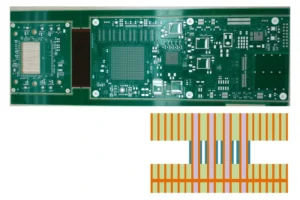
Different Rogers materials may require specific lamination conditions. Hybrid stackups, where Rogers materials are combined with FR4 or other materials, need extra attention because different materials may expand, bond, and behave differently during processing.
4. Drilling and Via Quality
Via transitions can affect RF performance. The manufacturer should review signal vias, ground vias, via stubs, back drilling requirements, plated through-hole reliability, and pad geometry.
5. Copper and Etching Control
High-frequency traces are sensitive to line width variation. Etching compensation, copper thickness, copper roughness, and trace edge quality should be controlled carefully.
6. Surface Finish Selection
Surface finish should be selected based on assembly needs, shelf life, RF performance expectations, and reliability requirements. ENIG, immersion silver, OSP, and other finishes may be considered depending on the application.
Mars-PCB provides Rogers high-frequency PCB fabrication support for customers who need material, stackup, impedance, and manufacturability review before production.
When Should You Use Rogers PCB Materials?
Rogers PCB materials are worth considering when your design has one or more of the following requirements:
| Requirement | Why Rogers May Be Considered |
| High operating frequency | Standard FR4 may show excessive loss or unstable behavior |
| Low insertion loss | Low-loss materials help reduce signal attenuation |
| Stable impedance | Controlled dielectric properties support transmission-line design |
| Phase-sensitive circuits | Stable Dk helps maintain predictable phase behavior |
| Antenna performance | Low-loss substrate can support efficient RF transmission |
| Microwave circuits | Material behavior becomes more critical at microwave frequencies |
| Thermal reliability | Some Rogers materials support demanding environments |
| Production repeatability | Stable material properties support consistent manufacturing |
Rogers materials are most useful when the PCB material directly affects RF performance, not when the board only needs basic electrical connection.
When Rogers Materials May Not Be Necessary
Not every PCB needs Rogers material. In some cases, using Rogers may increase cost without meaningful performance benefit.
Rogers materials may not be necessary when:
- The circuit operates at low frequency
- RF paths are short and not performance-critical
- Standard FR4 meets the loss budget
- Cost is more important than high-frequency performance
- The design is only for mechanical or basic electrical validation
- The application does not require controlled RF behavior
For some projects, a hybrid stackup may be a practical option. Critical RF layers can use Rogers materials, while non-critical layers may use other materials to manage cost and manufacturability. This approach should be reviewed carefully before fabrication.
What Information Should You Provide for a Rogers PCB Quote?
To get a more accurate quotation and faster engineering review, prepare a complete manufacturing data package.
| Information | Why It Matters |
| Gerber files | Defines copper layers, solder mask, and board geometry |
| Drill files | Defines hole sizes, locations, and via structure |
| Rogers material type | Confirms substrate selection and availability |
| Material thickness | Affects impedance and stackup |
| Copper weight | Affects loss, current capacity, etching, and impedance |
| Stackup drawing | Defines layer order and dielectric structure |
| Controlled impedance table | Supports impedance calculation and process planning |
| Board thickness | Affects mechanical fit and electrical behavior |
| Surface finish | Affects assembly and reliability |
| Quantity | Affects cost and production planning |
| Special RF notes | Helps identify sensitive areas and performance priorities |
| Approved alternatives | Can help reduce material lead time when acceptable |
For early-stage projects, engineers can contact Mars-PCB to discuss material availability, stackup feasibility, and manufacturing requirements before finalizing the design.
Common Mistakes in Rogers PCB Projects
Mistake 1: Choosing Rogers Material Only by Brand Name
Rogers offers different material families for different needs. A material should be selected according to Dk, Df, thickness, copper type, frequency, thermal conditions, and fabrication requirements.
Mistake 2: Ignoring Stackup Before Layout
The stackup affects impedance, trace width, loss, and manufacturability. Finalizing the layout before stackup confirmation can cause redesign or fabrication delays.
Mistake 3: Assuming Rogers Material Alone Solves RF Problems
Material helps, but it cannot fix poor RF layout, uncontrolled impedance, bad grounding, unnecessary via transitions, or connector launch issues.
Mistake 4: Using Tight Tolerances Everywhere
Tight tolerances increase cost and may affect lead time. Use tight tolerances where they matter electrically or mechanically, and keep other requirements practical.
Mistake 5: Not Checking Material Availability
Some Rogers materials, thicknesses, or copper options may require longer procurement time. Availability should be checked before urgent prototype planning.
Mistake 6: Sending Incomplete Files
Gerber files alone may not be enough. A Rogers PCB quote should include material, stackup, impedance, copper, surface finish, and special RF notes.
How to Choose a Rogers PCB Manufacturer
A Rogers PCB manufacturer should understand both PCB fabrication and high-frequency circuit requirements. The supplier should be able to review whether the selected material, stackup, trace geometry, and process requirements are practical.
When evaluating a manufacturer, consider:
| Supplier Capability | Why It Matters |
| Rogers material experience | Helps reduce processing and material handling risks |
| High-frequency PCB knowledge | Supports RF and microwave performance requirements |
| Controlled impedance capability | Essential for RF transmission lines |
| Stackup review | Helps align material, dielectric thickness, and trace geometry |
| Lamination control | Important for material bonding and dimensional stability |
| Copper and etching control | Supports lower loss and impedance consistency |
| DFM feedback | Prevents design and manufacturing issues before production |
| Prototype and production support | Helps move from sample testing to volume build |
| Communication speed | Reduces delays during material and engineering confirmation |
A reliable supplier should not only quote the board, but also identify potential risks before fabrication.
Mars-PCB supports custom Rogers PCB and high-frequency PCB manufacturing for RF, microwave, radar, antenna, and communication applications.
FAQ: Rogers PCB Materials
1. What are Rogers PCB materials?
Rogers PCB materials are high-frequency circuit laminates used for RF, microwave, antenna, radar, communication, and other applications where standard FR4 may not provide enough low-loss or stable electrical performance.
2. Why are Rogers materials used in RF PCB manufacturing?
Rogers materials are used in RF PCB manufacturing because they offer controlled dielectric properties, low-loss material options, stable impedance behavior, and better high-frequency performance than standard FR4 in many demanding applications.
3. Is Rogers PCB better than FR4?
Rogers PCB materials are often better than FR4 for RF and microwave circuits requiring low loss and stable dielectric behavior. However, FR4 may still be suitable for lower-frequency, cost-sensitive, or non-critical applications.
4. Which Rogers material is suitable for microwave PCB applications?
The right Rogers material for microwave PCB applications depends on frequency, Dk, Df, loss budget, thickness, copper foil, thermal conditions, and manufacturing requirements. RO4000, RO3000, and RT/duroid families are commonly considered for different microwave needs.
5. What affects Rogers PCB manufacturing cost?
Rogers PCB manufacturing cost is affected by material type, material thickness, copper option, layer count, board size, controlled impedance, surface finish, via structure, tolerance requirements, testing, quantity, and material availability.
6. Can Rogers materials be used in multilayer PCBs?
Yes, Rogers materials can be used in multilayer PCBs, but the stackup must be reviewed carefully. Hybrid multilayer boards may combine Rogers material with other substrates, but lamination compatibility and impedance control should be evaluated before fabrication.
7. What files are needed for Rogers PCB fabrication?
For Rogers PCB fabrication, you should provide Gerber files, drill files, material specification, stackup drawing, controlled impedance table, copper weight, board thickness, surface finish, quantity, and any special RF or microwave notes.
Conclusion
Rogers PCB materials are widely used in high-frequency circuit boards because they offer material options for lower loss, stable dielectric behavior, controlled impedance, and RF or microwave performance. They are especially useful in antennas, radar systems, RF modules, microwave circuits, satellite communication, 5G equipment, and phase-sensitive designs.
However, choosing Rogers material is not enough by itself. The final PCB performance also depends on stackup design, dielectric thickness, copper foil, trace geometry, via transitions, lamination quality, impedance control, and manufacturing communication.
For engineers and purchasing teams, the best approach is to select Rogers PCB materials based on actual frequency, loss budget, thermal conditions, impedance requirements, cost target, and fabrication feasibility.
If your project requires Rogers PCB materials for RF or microwave applications, Mars-PCB can support your development with high-frequency PCB manufacturing services and engineering-focused fabrication review.