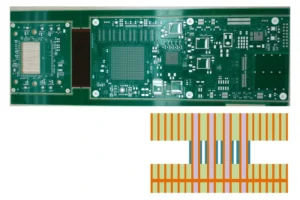
In the world of high-end electronics design, there is a “complexity ceiling” that every engineer eventually hits. You’ve mastered the 4-layer board, moved comfortably into 6-layer designs, and perhaps you are currently optimizing an 8-layer stackup. But as your project requirements evolve—incorporating faster processors, more high-speed data buses, and shrinking form factors—the question inevitably arises: Is it time to move to a 10-layer PCB?
Choosing between an 8 layer vs 10 layer PCB is not just about finding more space for traces. It is a strategic decision that affects signal integrity (SI), power integrity (PI), and electromagnetic compatibility (EMC). In this guide, we will share a professional and sincere look at when you truly need those extra layers and how they can transform your product from a “working prototype” into a “market-leading solution.”
1. Entering the Realm of High-Density Interconnect (HDI)
When we talk about 10-layer boards, we are entering the territory of advanced computing. This isn’t just about “adding two more layers”; it’s about a fundamental shift in how we manage electromagnetic fields.
The decision to upgrade from an 8-layer to a 10-layer PCB is typically driven by the need for better signal isolation, the management of multiple power rails, and the physical constraints of ultra-fine-pitch BGA components. While an 8-layer board is a high-performance workhorse, a 10-layer board is the standard for mission-critical applications like server motherboards, advanced medical imaging, and high-speed telecommunications.
Why Not 9 Layers?
A common doubt among users is whether they can choose a “7-layer” or “9-layer” board to save costs. As a partner in your manufacturing journey, we must be honest: You should always use an even number of layers. Manufacturing a 9-layer PCB creates an unbalanced stackup that causes the board to warp during the reflow soldering process, leading to “potato-chipping” and mechanical failure. To maintain board flatness and reliability, the industry standard jumps directly from 8 to 10 layers.
2. Anatomy of the 10-Layer Stackup: The Power of Symmetry
The “secret sauce” of a 10-layer board lies in its symmetry. In an 8-layer design, you often have to make compromises—perhaps sharing a plane for both power and signal or having unbalanced return paths.
The 10-Layer Advantage
A typical 10-layer stackup allows for a “Four Plane” approach. A standard professional configuration looks like this:
- Signal 1 (Top)
- Ground Plane 1
- Signal 2 (High-speed)
- Signal 3 (High-speed)
- Power Plane 1
- Power Plane 2
- Signal 4 (High-speed)
- Signal 5 (High-speed)
- Ground Plane 2
- Signal 6 (Bottom)
The primary structural benefit of a 10-layer PCB is the ability to have six signal layers perfectly shielded by four dedicated internal planes (Ground and Power), which ensures that every high-speed trace has a consistent reference plane directly adjacent to it. This symmetry prevents signal distortion and minimizes the risk of the board warping during production.
3. Signal Integrity (SI) and Extreme EMI Control
As clock speeds move into the gigahertz (GHz) range—think DDR5 memory or PCIe Gen 5—the PCB traces behave like complex antennas.
For high-speed designs, 10-layer PCBs provide superior EMI control because they allow for “Stripline” routing, where critical signals are sandwiched between two ground planes, effectively shielding them from both internal crosstalk and external electromagnetic interference.
Precision Return Paths
In an 8-layer board, signal layers 3 and 4 might share a reference. If a signal hops between layers, the “return path” can become discontinuous, leading to signal reflections and EMI failures. In a 10-layer design, you have enough layers to ensure that every high-speed signal transition has a nearby “stitching via” and a continuous ground plane, which is essential for passing strict FCC or CE Class B certifications.
4. Power Integrity (PI): Managing Multiple Voltage Rails
Modern FPGAs and SoCs (System on Chips) are “power-hungry.” They don’t just need 3.3V or 5V; they often require a dozen different voltage rails (e.g., 0.8V for the core, 1.2V for DDR, 1.8V for I/O).
A 10-layer PCB is often required when a design has multiple complex voltage rails because it provides dedicated internal layers for power planes, reducing “PDN noise” (Power Distribution Network noise) and ensuring stable voltage delivery to high-speed processors.
By having multiple dedicated power planes, you can:
- Partition Planes: Use one layer for multiple low-current voltages without them interfering with each other.
- Reduce IR Drop: More copper planes mean lower resistance, ensuring the chip gets exactly the voltage it needs.
- Decoupling Efficiency: Placing power and ground planes closer together (tight coupling) creates “plane capacitance,” which helps filter high-frequency noise.
5. Routing Density: Conquering the 0.4mm BGA
As components get smaller, the “escape routing” (getting the traces out from under the chip) becomes the bottleneck.
When working with ultra-fine-pitch BGA components (0.4mm or 0.5mm pitch), a 10-layer PCB is often the technical “floor” because it provides the necessary internal routing channels to fan out hundreds of pins without resorting to extremely expensive HDI features like stacked micro-vias.
In an 8-layer design, you might run out of layers to route the inner balls of a large BGA. By moving to 10 layers, you add two entire “highways” of routing space, allowing you to keep the trace widths and clearances large enough for standard (and more affordable) manufacturing processes.
6. Thermal Performance: Heat Dissipation in Tight Spaces
Heat is the silent killer of electronics. In high-performance systems, the PCB must act as a primary heat sink.
In terms of thermal management, 10-layer PCBs outperform 8-layer boards by providing more internal copper planes that act as a massive heat spreader, allowing thermal energy from high-TDP components to move vertically through thermal vias and dissipate evenly across the entire board surface.
If you are designing a product that will be housed in a sealed enclosure without a fan, those two extra layers of copper can be the difference between a stable system and one that throttles or fails due to overheating.
7. The Economics of Precision: Cost vs. Performance
We understand that cost is always a factor. Moving from 8 to 10 layers is a significant step.
Typically, a 10-layer PCB costs 40% to 60% more than an 8-layer board due to the increased material usage, more complex lamination cycles, and higher precision required for interlayer alignment.
Calculating the True ROI
However, the “Board Price” is not the “Total Product Cost.” Consider these factors:
- Reduced Design Time: More layers make routing easier and faster, reducing engineering hours.
- Elimination of External Shielding: Superior EMI on a 10-layer board may allow you to remove expensive metal shields or ferrite beads from your BOM.
- Faster Certification: Passing EMI/EMC tests on the first attempt saves thousands of dollars in re-testing fees and prevents product launch delays.
8. Comparison Table: 8-Layer vs. 10-Layer Performance
| Feature | 8-Layer PCB | 10-Layer PCB |
| Typical Usage | High-end Consumer, Industrial | Servers, Networking, Medical |
| Signal Shielding | Moderate (Good) | Maximum (Excellent) |
| Power Rails | 2-3 Major Rails | 4+ Complex Rails |
| BGA Pitch Support | Down to 0.5mm | Down to 0.4mm |
| Impedance Control | Standard | High-Precision |
| Relative Cost | 1.0 (Baseline) | 1.4x – 1.6x |
9. Decision Checklist: Is It Time to Upgrade?
If you are unsure, ask yourself these three questions:
- Does my design include DDR5, PCIe Gen 4/5, or signals above 5GHz? (If yes, move to 10 layers for SI).
- Do I have more than 5 different voltage rails for a single processor? (If yes, move to 10 layers for PI).
- Am I struggling to route a BGA with over 400 pins? (If yes, move to 10 layers for Density).
10. Conclusion: Choosing Excellence Over Convenience
In the debate of 8 layer vs 10 layer PCB, the “right” choice is the one that ensures your product works perfectly the first time it is powered on. While the 8-layer board is an impressive piece of engineering, the 10-layer board is where true high-speed design excellence happens.
We sincerely recommend that if your project is “mission-critical”—meaning failure is not an option—the added stability and shielding of a 10-layer stackup are well worth the investment. Don’t just design for today’s prototype; design for tomorrow’s market success.